By Anish Manandhar
Prayer Wheels.
  Naturally NepalNamaste! Join me as I take you on an adventure through Nepal in the heart of the Himalayas. Submissions are open!
Posted 680 weeks ago

Posted 680 weeks ago


Posted 680 weeks ago
Posted 680 weeks ago
Posted 680 weeks ago
Posted 680 weeks ago
Posted 680 weeks ago
That is so awesome! I think I’ve found my favorite Dashain tradition. I definitely did not know the Dashain bamboo swings had meaning behind it. Thanks for sharing, dude! (post)
Posted 680 weeks ago
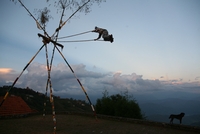
Nepali festivals: Dashain The Nepalese festival of Dashain is a few days away, so I thought I’d share some information on the festival and some traditions surrounding it. Keep in mind that I don’t live in Nepal and I’ve only fully celebrated Dashain as a little kid in Kathmandu. Also, different families have different traditions, so what I have listed below may not be something that all families do. Dashain in Nepal is celebrated to mark the occasion of the Hindu Goddess Durga defeating a demon (victory of good over evil). It is the biggest festival in Nepal, and lasts about 15 days in the fall. The festival begins with “Ghatasthapana” (gha-tas-tha-pa-na). An initial Puja is carried out to mark the beginning of the festival, and “jamara” (barley sprouts), used on the 10th day (main day) of the festival, is planted. On the 10th day, also called Tika day, people go to their elder relative’s houses to have Jamara and Tika put on, and receive blessings and Dakshina (you get money.. well most people do..it’s complicated). The Tika starts on the 10th day and goes on until the end of the festival. In between Tika day and Ghatasthapana (the 1st day), there is Fulpati. The only thing I know about Fulpati is that they have this huge parade/party in Tudikhel (open space for parades in the middle of Kathmandu) and they bring in horses and fire guns; it’s pretty awesome. I don’t exactly know why the Fulpati celebration is carried out, but I’m sure there’s some meaning to it. My family used to spend the days in between visiting various temples around the city and shopping for new clothes as it is traditional to wear new clothes on Tika day. I remember the stores in Kathmandu got ridiculously crowded around this time. Walking around the city, you can also hear traditional Dashain music known as “Mangal Dhun” playing in almost every single store. Other traditions include lots of gambling, drinking, eating goat and lamb meat (made with a special Dashain-only recipe), and for some families, animal sacrifices to Goddess Durga. My family, however, never took part in the animal sacrificing tradition. Flying kites (tradition known as: “changa chet” in Nepali) is also a major part of the festival. The main purpose of this is to have fun (obviously) and also to take down all the neighborhood kites. Whoever has taken down the most kites in the neighborhood gets to carry around the title of “badass” until the next Dashain. Huge bamboo swings are also put up all over the city and people take turns going on it. If you ever get a chance to swing on one of these things, I highly recommend you take it. I’m sure there is so much more to the festival that I’ve missed. Please feel free to correct me if I’ve made any mistakes or add onto this if I’ve missed anything.
Posted 680 weeks ago
Posted 681 weeks ago
|