Welcome to my website!

Naturally Nepal

Namaste! Join me as I take you on an adventure through Nepal in the heart of the Himalayas. Submissions are open!

Greetings: Happy Teej 2013

nepalgo:

Did you know that today is Teej, also known as HaritalikaTeej? This festival is celebrated by Hindu Women all across the country. The date of this festival fluctuates a lot, and this year it is on Bhadau 23rd 2070 (September 8th, 2013). Teej is written “तीज” in Nepali.

About the Festival

Teej is solely women’s festival, meaning on this day, only women celebrate it. Teej is a public holiday only for women, though. Prior to Teej, they eat a special meal called ‘Daar’ but due to modernization nowadays, they just eat normal food and call it ‘daar’. On this day, married women fast for their husband’s longevity and unmarried women fast in order to get a good husband. The Teej Women wear 'Rato Saree’ (red sari) and other ornaments. They usually go to Pashupatinath to worship on this day. They don’t break their fast until tomorrow and women spend their time dancing and singing. 

Men don’t observe this festival.

To greet people on this day, you can say : तीजको शुभकामना (teej ko shubhakamana)

Happy Teej everyone, especially to Women!

Teej ko subhakamana sabai jana lai! This year Teej falls on Bikram Sambat 30 Bhadau 2072 (Nepali Calendar) and September 16, 2015 on the western calendar. 

Posted 578 weeks ago
tumblr photo tumblr photo tumblr photo tumblr photo tumblr photo
Posted 578 weeks ago
tumblr photo tumblr photo tumblr photo tumblr photo tumblr photo
Posted 579 weeks ago

Nepali festivals: Dashain

nepal:

The Nepalese festival of Dashain is a few days away, so I thought I’d share some information on the festival and some traditions surrounding it. Keep in mind that I don’t live in Nepal and I’ve only fully celebrated Dashain as a little kid in Kathmandu. Also, different families have different traditions, so what I have listed below may not be something that all families do. 

Dashain in Nepal is celebrated to mark the occasion of the Hindu Goddess Durga defeating a demon (victory of good over evil). It is the biggest festival in Nepal, and lasts about 15 days in the fall. The festival begins with “Ghatasthapana” (gha-tas-tha-pa-na). An initial Puja is carried out to mark the beginning of the festival, and “jamara” (barley sprouts), used on the 10th day (main day) of the festival, is planted. On the 10th day, also called Tika day, people go to their elder relative’s houses to have Jamara and Tika put on, and receive blessings and Dakshina (you get money.. well most people do..it’s complicated). The Tika starts on the 10th day and goes on until the end of the festival. In between Tika day and Ghatasthapana (the 1st day), there is Fulpati. The only thing I know about Fulpati is that they have this huge parade/party in Tudikhel (open space for parades in the middle of Kathmandu) and they bring in horses and fire guns; it’s pretty awesome. I don’t exactly know why the Fulpati celebration is carried out, but I’m sure there’s some meaning to it. 

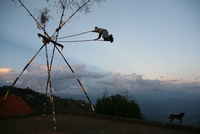
My family used to spend the days in between visiting various temples around the city and shopping for new clothes as it is traditional to wear new clothes on Tika day. I remember the stores in Kathmandu got ridiculously crowded around this time. Walking around the city, you can also hear traditional Dashain music known as “Mangal Dhun” playing in almost every single store. Other traditions include lots of gambling, drinking, eating goat and lamb meat (made with a special Dashain-only recipe), and for some families, animal sacrifices to Goddess Durga. My family, however, never took part in the animal sacrificing tradition. Flying kites (tradition known as: “changa chet” in Nepali) is also a major part of the festival. The main purpose of this is to have fun (obviously) and also to take down all the neighborhood kites. Whoever has taken down the most kites in the neighborhood gets to carry around the title of “badass” until the next Dashain. Huge bamboo swings are also put up all over the city and people take turns going on it. If you ever get a chance to swing on one of these things, I highly recommend you take it.         

 I’m sure there is so much more to the festival that I’ve missed. Please feel free to correct me if I’ve made any mistakes or add onto this if I’ve missed anything. 

To add onto this (one of my followers mentioned it) the reasoning behind the bamboo swings (called linge ping in Nepali): it is believed that when you swing on the linge ping, your weight is suspended in air, which makes the earth lighter. It is also believed that riding on these swings will bring good fortune.

Posted 579 weeks ago

Step 1: Learn some Nepali. Step 2: Impress people.

neon-deitrick:

thisisantiasianracism:

bangla-desi:

nepal:

Hello: Namasté! (Nah-mas-teh)

Good-morning: Shubha prabhat/ Shubha bihani (shoe-bha pra-bhat/ shoe-bha bee-ha-ni)

Thank-you: Dhanyabad! (dhan-ya-baad)

How are you? (formal): Sanchai hunuhuncha? (San-chai hu-nun-cha)

I’m doing very well: Sanchai chu. (San-chai choo)

How’s it going? (informal): K cha? 

It’s good: Thik cha (Theek cha)

What’s your name? (formal): Hajur ko nam ke paryo? (hah-joor koh nam ke par-yo) OR [slightly less formal] Tapai ko nam ke paryo?

What’s your name? (informal): Timro nam ke ho? (tim-roh nam ke ho?)

My name is ___: Mero nam _____ ho. (meh-roh nam ____ hoh)

Sorry, I don’t understand: Maf garnu hola, mailey bujhina. (maaf gar-noo hoe-la, mai-leh boo-jhee-nah)

How much is this?: Yesko kati? (Yes-ko ka-tee)

Different versions of “you” in Nepali: Hajur (hah-joor) [very formal], Tapai (tah-pai) [less formal], Timi (tee-me) [informal], Taa (tonh, nasal sounding) [very informal]. I’ll have to make a different post explaining situations where you’d have to use each one. 

“maf garnu hola, mailey bujhina” sounds a lot like “maaf koren, ami bujhina” in the Bengali I speak

Yeah I know in Kolkata Bengali it’s “ami bujhina” however I am uncertain over how to say “sorry” in Kolkata bengali since most people in Kolkata just say “sorry”
-Mod N

Nepali is derived from Sanskrit so it does have a lot in common with Hindi, more so since Nepal has the same Hindi shows lol. But similarities could be shared between neighboring areas due to area of influence and also the large number of Nepalese diaspora living around the Nepal-India border, Bangladesh-India border, and Bhutan as well as neighboring borders with India and Bangladesh!

Posted 579 weeks ago
<p><a href="http://peripatetic-mind.tumblr.com/post/128703434694/kathmandu-nepal-2015" class="tumblr_blog">peripatetic-mind</a>:</p>

<blockquote><p>Kathmandu, Nepal. (2015)</p></blockquote>

peripatetic-mind:

Kathmandu, Nepal. (2015)

Posted 579 weeks ago
<p>Fruit seller. Nepal</p>

Fruit seller. Nepal

Posted 579 weeks ago
<p><a href="http://arjuna-vallabha.tumblr.com/post/128883652642" class="tumblr_blog">arjuna-vallabha</a>:</p>

<blockquote><p>Kathmandu Durbar Square, Nepal</p></blockquote>

arjuna-vallabha:

Kathmandu Durbar Square, Nepal

Posted 579 weeks ago
tumblr photo tumblr photo tumblr photo
Posted 579 weeks ago

The White Girl’s Guide To Not Being Ignorant

ghannoum:

A lot of people don’t realize that in their attempt to take part in a culture, they’re actually being incredibly racist. Of course, sometimes it’s not their fault! Some people really just aren’t aware that they’re being disrespectful. So, to avoid that problem here’s a handy guide to figure out if what you’re doing is ignorant as hell:

“Wow I really love the style of [blank] clothing!”

  1. Appropriation: Wearing a bindi, headdress, or kimono to Coachella or Hard Summer to complete your ‘bohemian/g*psy/earth goddess’ look. Not only do you look stupid, but you’re also being racist. Those aren’t even the same cultures. Stop it.
    **For those wondering why it’s racist to wear something like a bindi or kimono, have your hair in dreads, etc, the answer is quite simple: people get ridiculed all the time for embracing their culture, and some are forced to completely alter their identity for school, work, etc. However, as soon as white people wear the same exact things, it suddenly becomes ‘fashion’. You can’t simultaneously degrade someone for their culture, but still want to wear it as a costume.That’s why it’s racist.
  2. Appreciation: Have your best friend’s traditional Indian wedding to go to? Great, ask if you can wear a sari then go ham. Invited to an event at a religious space? Go ahead and don the respective attire in order to, you know, be respectful.

“[Blank] language is so beautiful!”

  1. Appropriation: Getting a tattoo in a language you don’t know because you enjoy the ~*~~*~aesthetic~*~~*~ of said language.
    **This also goes for slang/aave. For example, if you’re not Black, don’t use the N-word. Don’t even argue with this.
  2. Appreciation: Learn to read, write, and/or speak the language that you’re so obsessed with. Simple stuff.

“I really like the idea of [blank] religion!”

  1. Appropriation: Captioning ‘#namastebitches’ with the Om symbol on your weekly yoga instagram post, keeping a Buddha statue in your room because it’s ‘just so cute!’, wearing a headscarf because it’s trendy, and/or wearing religious symbols as a part of your #ootd. You’re minimizing the significance of all these religious aspects and frankly, you’re being rude.
  2. Appreciation: Learning about the religion and visiting various places of religious worship in order to get some hands on experience with it.

“The art, music, literature, etc from [blank] is so cool!”

  1. Appropriation: Buying henna kits from your local Walmart, purchasing mass produced ‘ethnic’ art, or supporting white people writing about their completely life-changing and inspirational ‘Eat, Pray, Love’ experiences in a random foreign country.
  2. Appreciation: Support artists from the culture you’re admiring. Buy their books and visual art pieces, go to their shows, signal boost their work, etc. If you really love their work, you’ll get it from the source.

“I love [blank] food!”

  1. There is literally no way to appropriate this. Just enjoy the damn food and credit it to its proper culture. Take it one step further and go to actual Mexican-owned Mexican restaurants instead of Taco Bell.

In a nutshell, things you as an outsider may find insignificant are things that we actually find to be really important aspects of our identity. All we ask is that you respect that, put in the effort to research what you may be doing or wearing or saying, and if you have any questions: there are literally millions of us to ask. Literally millions.

Now take your new knowledge and go forth, dear friends. Don’t be dumb. I believe in you.

[If you’d like to read the article (or others like it) on Coming of Faith’s site, click here!]

Posted 579 weeks ago

About Me

I grew up in a small town helping my parents on their farm. There I developed my love for nature and a desire to explore. Now I travel around the world photographing nature.

Interests

I love to travel. I have been everywhere, from Alaska to Zimbabwe. For every trip I keep a travel log of my adventures and capture the world as I see it.

Check out my photo gallery to get a glimpse into where I have been. And drop me a line if want to find out more. I always love to hear from fellow travelers.

Aspirations

I am looking for my next big adventure. There are still many places I want to visit and even more to which I want to return. The camera is charged up and my backpack is packed; drop me a line if you know where I should go next.